Mental health, in general, is a subject that open conversations about have only really become common over the last few years. People are only now starting to feel more comfortable using labels like anxiety, depression, and trauma.
But even now, within the South Asian community, mental health is still rarely talked about openly. It’s often seen as taboo — something to hide, something to deal with quietly, something that should never be discussed outside the home.
So growing up nearly 30 years ago, struggling with social anxiety and depression in a super strict Indian household, you can imagine how lonely that felt.
I didn’t feel like I could talk to anyone about what was happening inside my head.
I didn’t know how to explain how terrified I felt in large groups. How the thought of speaking in public made me feel physically sick. How my chest would tighten and my stomach would twist before family gatherings.
Talking about mental health with parents when the subject itself is taboo is difficult.
But in a toxic family environment, it’s even harder.
There was one time when my parents did find out about my depression. I had been so low that I took a bunch of tablets. The school found out and, naturally, my parents were called in. They were made aware of what had happened.
That moment could have been the beginning of healing.
It could have been the moment my family sat down with me and asked, “What’s going on? Why is our daughter hurting this much?”
But that’s not what happened.
Instead, it was turned against me.
I was made to feel like I had let my parents down. Like I had embarrassed them. Like I was the failure.
Instead of concern, there was anger.
Instead of support, there was shame.
That moment reinforced something very clearly in my mind:
Keep your thoughts to yourself.
Keep your feelings to yourself.
Never trust anyone with your pain.
And that’s exactly what I did.
I carried that silence into adulthood. I was always uncomfortable talking openly about my family or my mental health struggles. Even my husband didn’t fully understand what my home life was like before we got married.
It was only after he moved in with us that he began to see it for himself — how toxic the environment really was, and how much of my anxiety and depression stemmed from it.
And that’s when something hit me.
What I had grown up thinking was “normal” … wasn’t normal.
The constant walking on eggshells.
The fear of saying the wrong thing.
The emotional outbursts that were brushed under the carpet five minutes later.
The pressure to always be perfect.
In our community, we are taught to protect our parents at all costs. To never speak badly about them. To never expose what happens inside the home.
Silence equals loyalty.
But that silence was suffocating me.
Silence
In many South Asian families, silence isn’t enforced loudly. It’s taught quietly.
You learn very early what is safe to talk about — and what is not.
Mental health was not safe.
Feelings were not safe.
Questioning authority was definitely not safe.
Even after my overdose, there was no real conversation. No counselling was arranged. No one checked in to see how I was coping afterwards.
Just disappointment.
When a child learns that their pain causes anger instead of concern, they stop sharing.
They stop trusting.
They stop asking for help.
And that silence follows them into adulthood.
Shame
The shame ran deep.
Not just because I was depressed — but because I believed I was weak for being depressed.
In many South Asian communities, there is a strong expectation to be resilient, grateful, and strong no matter what. You are taught to push through.
So when you can’t push through, you start to feel broken.
I internalised everything.
If I felt anxious, I told myself I was being dramatic.
If I felt depressed, I told myself I was ungrateful.
If I was struggling, I told myself to try harder.
Even after getting married, I protected my parents’ image. I minimised things. I downplayed the toxicity. Because in our culture, “family matters stay in the family.”
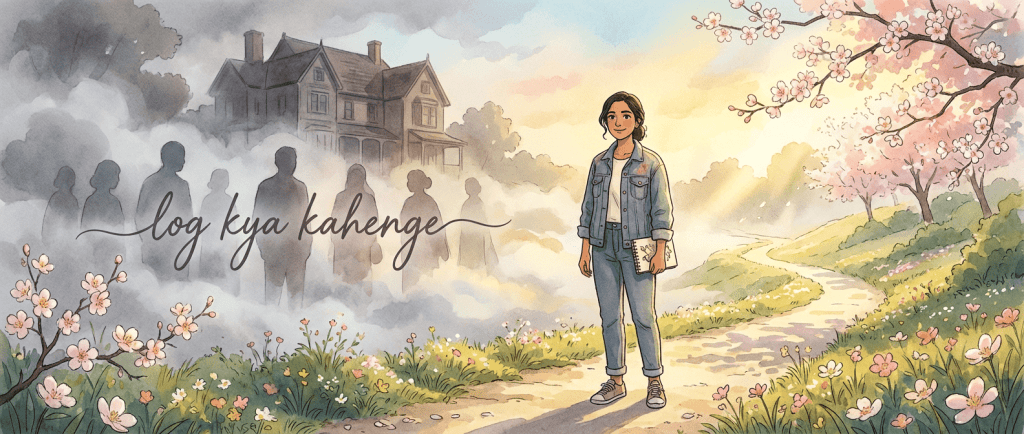
“Log kya kahenge” doesn’t always need to be said out loud.
It lives inside you.
“Log Kya Kahenge”
What will people say if they know your daughter tried to take tablets?
What will people say if they know your family has problems?
What will people say if you go to therapy?
These invisible “people” hold enormous power in our culture.
Sometimes more power than our own children’s wellbeing.
Looking back now, I realise something painful but also freeing:
My family’s reputation was protected more than my mental health.
And I see this pattern everywhere in the South Asian community.
We celebrate success loudly.
But we bury pain quietly.
We invest heavily in careers.
But rarely in emotional awareness.
We teach our children how to achieve.
But not how to cope.
Why It’s Still So Hard
Speaking up about mental health in our community is still difficult because it can feel like betrayal.
It feels like you’re exposing your family.
It feels like you’re being disloyal.
And loyalty is deeply rooted in our culture.
But here’s something I’ve learned over the years:
There is a difference between loyalty and self-abandonment.
Staying silent was costing me my mental health.
Staying silent was feeding my anxiety.
Staying silent nearly cost me my life.
That isn’t loyalty.
That’s survival.
And survival is not the same as healing.
Breaking the Silence
I’m not writing this from a place of blame anymore.
I understand that my parents didn’t have the tools. Mental health wasn’t openly discussed in their generation either. For them, survival, sacrifice, and reputation came first.
But understanding something does not mean repeating it.
And that’s where change begins.
With us.
With uncomfortable conversations.
With therapy.
With boundaries.
With saying, “That hurt me.”
With telling our children, “It’s safe to talk to me.”
Mental health conversations in South Asian families are still difficult because we are undoing decades of silence, shame, and fear of judgement.
But every time one of us chooses honesty over image, we weaken that cycle.
Every time we say, “I’m not okay,” we create space for someone else to say it too.
I refuse to let silence raise my daughters.
I refuse to let shame define their worth.
And I refuse to let “log kya kahenge” matter more than their emotional safety.
Maybe I didn’t grow up in a home where mental health was understood.
But I can create one where it is.
And that’s how generational cycles begin to break.
Not loudly.
Not perfectly.
But intentionally.
Discover more from Usha Singh-Das | Breaking Free
Subscribe to get the latest posts sent to your email.
 Usha Singh-Das | Breaking Free