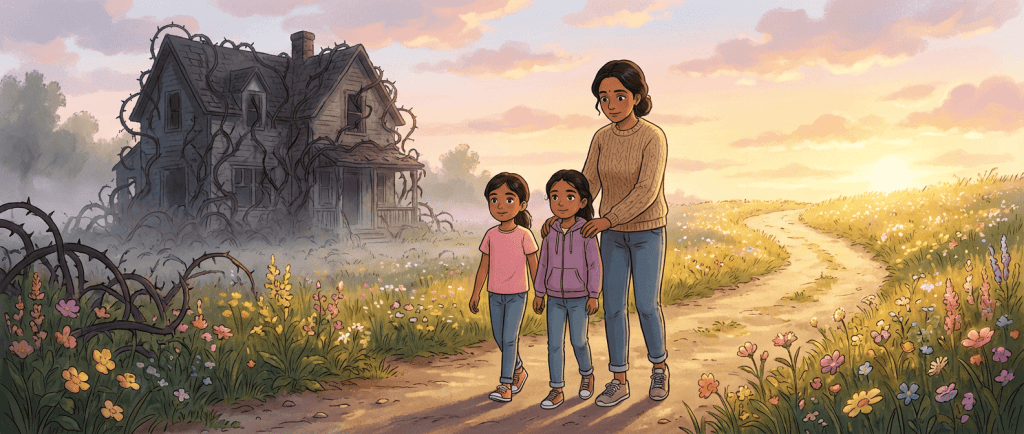
Generational trauma isn’t something I read about in books.
It’s something I witnessed inside my own family.
Growing up with a narcissistic father meant my siblings and I were raised in an environment where emotional safety didn’t really exist. We were all affected by it in different ways.
The difference between me and my brothers is this:
I chose to break the cycle.
They unknowingly continued a version of it.
My brothers weren’t narcissists. But the families they built reflected unresolved trauma in different forms.
One brother married someone who prioritised a Western social lifestyle over motherhood. There’s nothing wrong with wanting independence — but when you have children, they need presence. Her sons often felt secondary to everything else going on in her life.
The other brother’s household went in the opposite direction — but the outcome was even more damaging.
His wife believed her sons could do no wrong. Their aggression was celebrated. Their behaviour was excused. Meanwhile, when my brother disciplined them, it escalated into corporal punishment. What started as slaps turned into whatever object was within reach. Over time, the boys became immune to it. They would laugh while being hit. And it was spoken about almost as a badge of strength — that they could “take a beating.”
That dysfunction had consequences.
All three boys eventually had serious run-ins with the law.
One became involved in drug dealing.
One fabricated a criminal accusation that collapsed in court.
The youngest caused a fatal car crash while under the influence of drugs, resulting in the deaths of two passengers and life-altering injuries to another driver. He was later sentenced to prison.
When I look at it, I don’t just see “bad choices.”
I see unresolved trauma.
I see emotional neglect.
I see extremes — either no boundaries or violent ones.
I see children who were never truly seen, heard, or guided.
And I made a decision long before I had my own children:
That would not be my story.
Choosing a Different Path
I am a mum. I also now have a public presence — podcasts, interviews, events, travel.
Life is busy.
But the difference is this: my children were my priority long before I built anything online.
I spent the first eight years of Maanvi’s life and the first five years of Jiya’s life as a stay-at-home mum. I didn’t work. I poured myself into raising them. I only started working once Jiya was in full-time school. And it’s only in the last few months that my public work has expanded.
Even now, I structure my job around my children.
I start work at 6am. I am not a morning person — at all. But by 2pm, I’m done. That gives me afternoons and evenings with them. I could easily work 9–5. It would be easier for me. But it would give me barely any time with them before bedtime.
And I know how fast this stage of life disappears.
Maanvi is already 11, almost 12. Secondary school. WhatsApp chats with friends are starting to take priority over chats with mum — and that’s normal. But I’ve built a relationship where she knows I am safe. I check in with her intentionally. I create space for her to talk.
Jiya is different. She’s loud, funny, argumentative with her sister — so I assumed she was expressive. It was my husband who gently pointed out that when it comes to her feelings, she stays quiet. She doesn’t want to “bother” anyone.
That hit me hard.
So we created something small but meaningful — weekend mummy-and-daughter mornings. While everyone else sleeps in, I wake up at 8am (again, not my natural choice!) so she gets two uninterrupted hours of just me.
No distractions.
No rushing.
Just connection.
Because I’ve seen what happens when children don’t feel seen.
Accountability and Balance
We’re not perfect parents.
Life gets hectic. I get tired. Sometimes I’m not at my best. But my husband and I hold each other accountable. If he feels the girls need more time with me, he’ll say it. If I see something that needs correcting, I address it.
Our daughters are kind, smart, respectful girls. We’re proud of them. But we don’t idolise them blindly. They are children. They will make mistakes. And when they do, we correct them.
Not with violence.
Not with neglect.
Not with ego.
But with boundaries, love, and consistency.
I am the disciplinarian in our home. I hold everyone accountable — including my husband — and he does the same for me.
Because I have seen both extremes:
Children who are never corrected.
And children who are only corrected through fear.
Neither creates emotionally healthy adults.
The Cycle Ends With Me
Generational trauma doesn’t disappear by accident.
It ends when someone becomes aware enough — and brave enough — to do the work.
I saw what unresolved pain did to my siblings’ families. I saw how quickly trauma can shape parenting decisions. And I decided my past would not dictate my children’s future.
Have I done everything perfectly? No.
But my daughters are raised with love, structure, safety, and accountability.
And that, to me, is breaking the cycle.
Discover more from Usha Singh-Das | Breaking Free
Subscribe to get the latest posts sent to your email.
 Usha Singh-Das | Breaking Free