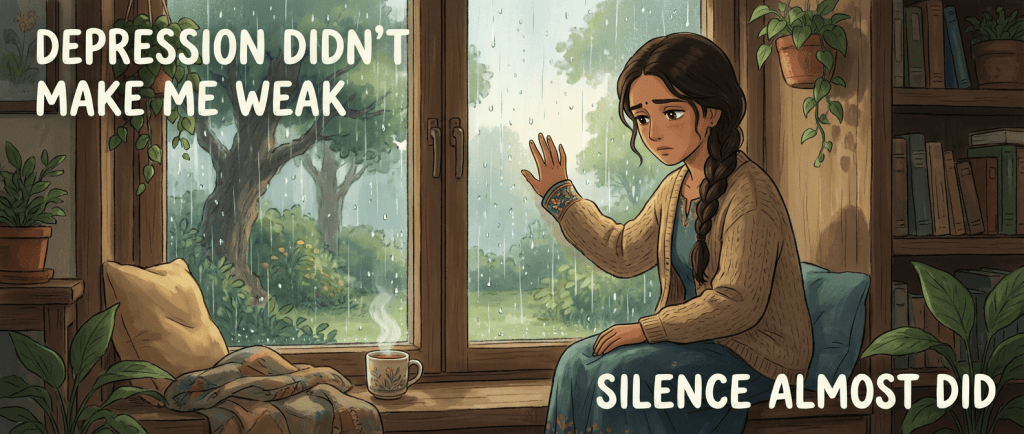
I have had depression since I was a teenager. This is something I don’t hide anymore.
I used to.
I was always made to feel like having a mental health problem was something shameful… like I was broken.
My depression, in my opinion, stemmed from my toxic family. I might have been prone to depression, but my environment was the trigger that aggravated it to the point where I was deeply unhappy with my life… and at times, I wished to end it.
I was lonely.
I didn’t have anyone to vent to.
No one to share my worries and fears with.
No one to laugh with.
No one I felt I could rely on to love me unconditionally.
That loneliness became the foundation of my depression.
And I worked through it… alone.
For some reason, in Asian culture, any sort of issue a person has—whether mental, physical, or emotional—if you are not “perfect,” you are made to feel like an outcast.
Like you need to be fixed.
Or kept at a distance.
I have seen both sides.
When I was “perfect”… and when I wasn’t.
Growing up, I was the perfect girl. Fair, pretty, and born in the UK. I was adored by everyone, both in the UK and in India. I was shown off, told I was beautiful, and paraded around like a doll.
But when I developed eczema, everything changed.
I was glared at.
People avoided me.
I was pitied.
And that shift… it stays with you.
I don’t know why, in the South Asian community, we treat each other like this. Nothing hurts more than the people who are supposed to be your support system—your tribe, your community—the ones who should lift you up…
being the ones who bring you down.
I can’t even remember how many times my own extended family made me feel awful and unwanted.
And that only added to my depression.
What made it worse wasn’t just what I was going through…
It was the silence around it.
No one talked about mental health.
No one asked if I was okay.
And I didn’t feel like I was allowed to speak.
So I stayed quiet.
And over time, that silence turned into shame.
I started to believe the narrative.
That something was wrong with me.
That I was weak.
That I had to hide parts of myself to be accepted.
But depression didn’t make me weak.
Silence did.
Silence is what kept me trapped in my own thoughts.
Silence is what made me feel alone, even when I was surrounded by people.
Silence is what stopped me from asking for help when I needed it the most.
Things are different for me now… especially as a mum.
Thankfully, neither Jiya nor Maanvi have struggled with depression. Maanvi did experience anxiety when she was younger. She would get so overwhelmed by change—like a new class or a new teacher—that she would physically be sick.
But over the years, she has grown through it.
She’s gone on overnight school trips, handled big changes like moving from primary to secondary school, and she’s thriving. She’s involved in school plays, part of the music club, the drama club—and honestly, she’s doing better than I ever imagined.
Jiya has her own worries too. She has mild anxiety and tends to put everyone else before herself.
But the difference is… they are not dealing with it alone.
Because I am a different kind of parent.
I won’t hide things from them.
I won’t make them feel unwanted.
And I will never make them feel like a failure for struggling.
They will grow up knowing that it’s okay to not be okay.
That their feelings are valid.
That they can talk to me—openly, honestly, without fear of judgement.
Because I know what it feels like to not have that.
Mental health is something that needs to be spoken about more openly—especially in our communities.
Because staying silent doesn’t protect us.
It isolates us.
It shames us.
It breaks us.
Depression didn’t make me weak.
But being forced to stay silent almost did.
And that’s a cycle I refuse to pass on
Discover more from Breaking Free
Subscribe to get the latest posts sent to your email.
 Breaking Free