Growing up, I was never treated like a girl.
At least, that’s how it felt to me.
I didn’t wear pretty dresses. I wasn’t encouraged to explore makeup or jewellery as a teenager. My wardrobe was baggy hoodies, oversized tops and loose jeans. Practical. Comfortable. Invisible.
But the truth is… I wanted to be girly.
I grew up watching Bollywood movies, completely mesmerised by the actresses in their beautiful, colourful outfits. The makeup. The jewellery. The elegance. I remember wishing so deeply that I could dress like that too.
But I was never allowed.
So when I had two daughters, I made a quiet promise to myself:
I would never restrict them in the way I felt restricted.
I wanted them to be free to discover who they were.
⸻
When they were babies, I quickly realised something funny — “girly” baby clothes are not always comfortable. Lace, frills, stiff fabrics… they look adorable, but they aren’t always practical for tiny humans trying to explore the world.
So my husband and I made a simple rule: comfort comes first.
Their wardrobes became a mix of everything.
Cute tops and jeans during the day.
Comfy boys’ pyjamas at night.
No rules. No labels. Just comfort.
And as they grew older, we followed their lead.
Maanvi was always more tomboy-ish. Comfort over style. Trainers over sparkles. But then there were moments — birthdays, parties — when she did want to wear dresses. So we bought the dresses.
Now, as a pre-teen, she’s discovering makeup. And we’re encouraging it gently — age-appropriate, sensitive skin products, and constant reminders that makeup enhances beauty, it doesn’t create it. She is beautiful with it, and without it.
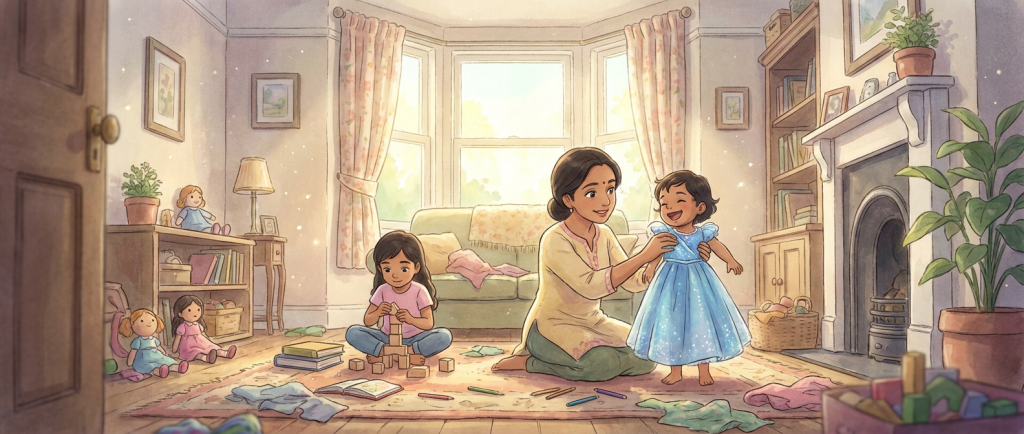
Jiya, on the other hand, has always been our girly girl. Dolls, dress-up, sparkles — she loved it all from the very beginning. So we supported that too.
Same parenting. Same freedom. Different personalities.
And that’s the point.
⸻
The same thing applied to toys and hobbies.
Jiya loved dolls and dressing up.
Maanvi loved books, activity toys and building blocks.
So we bought dolls.
We bought books.
We bought dress-up outfits.
We bought Lego.
Because growing up, my interests were never encouraged.
My love of reading wasn’t nurtured.
My passion for crafts wasn’t supported.
My interest in writing wasn’t taken seriously.
And I never realised how much that affected me… until I became a parent.
I made it a mission to support my girls in their passions.
And in doing that, something unexpected happened.
I started healing parts of myself too.
⸻
Maanvi has always been my mini-me.
She loves writing, just like I did as a child. When she was five, I found an opportunity called the Child Author Project. One hundred children were invited to write pieces based on a theme, and their work would be published in a book.
I signed her up immediately.
The project ran for three years.
Four books were published.
Maanvi was part of all four.
And every single one became an Amazon bestseller.
Watching her see her words in print… watching her confidence grow… it felt like healing a tiny version of myself that never got that opportunity.
⸻
For years, I thought I was just trying to be a better parent than my parents were to me.
But what I didn’t realise was that I was reparenting myself at the same time.
My husband has always been incredibly supportive. He has never questioned my spending or made me feel guilty for investing in things I enjoy — something that was very different from my childhood.
After Maanvi was born, I slowly started trying things I’d always been interested in. By the time Jiya arrived, my confidence had grown enough that I started small craft businesses while being a stay-at-home mum.
Crafting reignited something in me.
It rebuilt my confidence.
It brought back my creativity.
It reminded me who I was before life told me who I should be.
And as my confidence grew, I saw the same confidence growing in my daughters.
⸻
That’s the thing about parenting while healing.
You think you’re teaching them.
But so often… they are teaching you.
They teach you what freedom looks like.
What encouragement looks like.
What unconditional support looks like.
They show you what you deserved all along.
Raising daughters while reparenting yourself is emotional. It’s messy. It’s beautiful. And sometimes, it’s painful.
Because every time you give your children something you didn’t receive, a small part of you realises what you missed out on.
But instead of resentment, something softer grows.
Understanding.
Compassion.
Healing.
And the most powerful part?
The cycle changes with you.
It doesn’t end with you feeling broken.
It ends with your daughters feeling whole. 💛
Discover more from Breaking Free
Subscribe to get the latest posts sent to your email.
 Breaking Free