Sometimes, when I think I’m over my childhood trauma — when I truly believe I’m not letting my past define my present — I catch myself doing something that pulls me straight back. And it’s usually in those moments that I realise I’ve repeated something with my daughters that my family once did to me.
It’s never anything huge. It’s not bullying or putting them down. It’s quieter than that, and maybe that’s what makes it harder to notice.
It’s not listening properly when they’re talking.
It’s telling them to come back later because I’m busy blogging, working, or mentally elsewhere.
And yes, I do that.
I’m not proud of it. But when I notice it, I try to repair it. I acknowledge it. I name it. And I try to make things right with my girls — because that part matters.
Recently, it’s shown up in a way that made me uncomfortable to admit: I’d been unintentionally overlooking Jiya in favour of Maanvi.
Maanvi is going through a lot of change right now. She’s moved from primary school to secondary school. She’s stepping into her pre-teen years, navigating emotional highs and lows. And she’s recently started her period — something that’s been unsettling and confusing for her.
Naturally, my attention has leaned more towards her.
A couple of nights ago, Jiya came to me while I was in bed and asked for cuddles. There was something in the way she asked — quiet, careful — that told me she needed me.
So we cuddled under the duvet. I gently started talking to her, asking if she was okay, if there was anything she wanted to say.
Jiya is a funny one. She’s bubbly, loud, cheeky, fiery, and a total drama queen. But when it comes to her feelings, she’s incredibly introverted.
She’s had a minor speech issue since she first learned to talk — nothing major, but she speaks quite nasally and can sometimes be hard to understand. Because of that, she tends to keep things to herself.
And yet, that quietness isn’t really her.
Because I know her personality so well, I think I’ve unconsciously assumed she’s okay.
I’ve focused more on Maanvi, who has always been sensitive, emotional, and open. Maanvi talks — endlessly. From the moment she could speak, she narrated everything she felt, thought, or wanted. With her, emotional connection felt instinctive. I simply gave her what she asked for.
But Jiya doesn’t ask.
My husband noticed it before I did. He gently said that Jiya seemed a little sad lately — that she might need a bit more attention from both of us.
So we adjusted.
He started spending more one-on-one time with her in the evenings. I started creating more space — for conversations, for connection, for simply being present.
And that’s when I realised something uncomfortable.
I don’t actually know how to emotionally support a child who doesn’t hand me their feelings on a plate.
Because I never had that kind of emotional support myself.
I wasn’t taught how to sit with feelings, name them, or express them safely.
With Maanvi, it felt familiar. She’s like me — sensitive, expressive, emotionally open. But Jiya is a blend of me, my husband, and even a little of my dad.
And if I’m being completely honest, I sometimes find it hard to know how to comfort her in the way she needs.
But I’m trying.
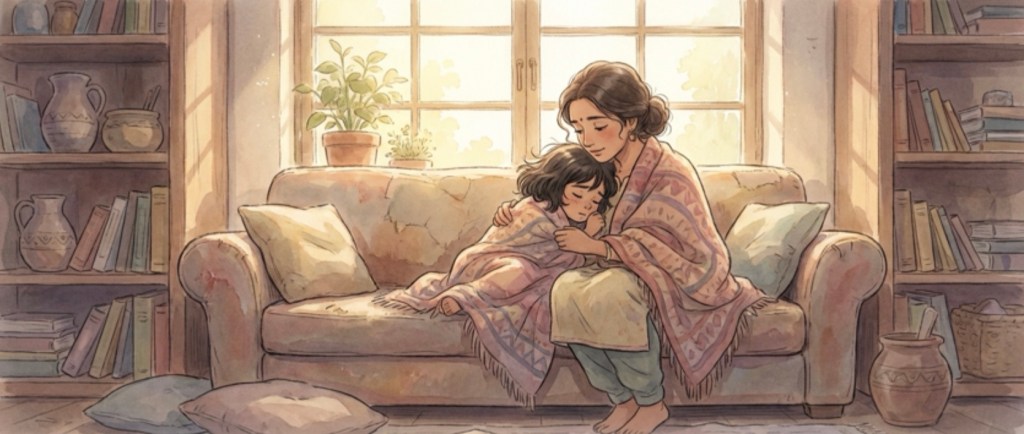
I’ve started movie mornings with her. She wakes up early on weekends, so now I do too. We sit on the sofa, wrapped in blankets, watching a film together before Maanvi and her dad wake up.
No pressure to talk.
No deep questions.
Just closeness.
Just consistency.
And slowly, it’s working.
What this experience has taught me is that healing from childhood trauma doesn’t mean we’ll never repeat old patterns. It means we notice them sooner. It means we pause, reflect, and choose repair instead of denial.
I won’t always get it right as a parent. Sometimes my past will still show up in my parenting.
But the difference is this: my daughters are allowed to feel it. They are allowed to name it. And they are met with accountability, honesty, and love.
I’m learning that breaking generational cycles isn’t about being a perfect, emotionally healed parent. It’s about being a present one.
One who listens.
One who apologises.
One who adjusts.
One who keeps showing up — even when it brings up parts of herself she’d rather not face.
And if my daughters grow up knowing that their feelings matter, that they are seen even when they are quiet, and that repair is always possible — then maybe that’s enough.
Maybe that’s what healing, motherhood, and breaking the cycle really looks like.
Discover more from Breaking Free
Subscribe to get the latest posts sent to your email.
 Breaking Free